
-
Where does it hurt?
Common conditions
Treatments
- Fees
- Corporate DSE
- Programs
- Shop
- Contact
Mappin House, 4 Winsley St, London W1W 8HF
Mappin House, 4 Winsley St, London W1W 8HF
How osteopathy differs from other manual therapies, how each profession is regulated, and how to choose the right care for your symptoms.

Many professions can help with musculoskeletal pain, sports injuries and everyday aches, and it is not always clear who does what. This guide explains what osteopathy is, how it compares with other manual therapies, and how to choose.
Osteopathy is a manual therapy that looks at how the bones, muscles, ligaments and connective tissue work together. Osteopaths use hands-on techniques, from gentle soft-tissue work to joint mobilisation, and often add exercise and lifestyle advice. See the NHS overview of osteopathy for more.
Osteopathy is statutorily regulated in the UK. Osteopaths must be registered with the General Osteopathic Council (GOsC) to practise, and the title is legally protected.
Physiotherapy. Physiotherapy focuses on restoring movement and function after injury, illness or disability, using exercise, education and manual therapy. Physiotherapists are regulated by the Health and Care Professions Council (HCPC). The NHS offers physiotherapy, and in many areas you can refer yourself.
Massage therapy. Massage works on muscle tension and soft tissue and can help with relaxation. Massage therapy is not statutorily regulated, but many practitioners register voluntarily with the Complementary and Natural Healthcare Council (CNHC).
Chiropractic. Chiropractic care centres on the spine and joints, with a focus on spinal adjustment. Chiropractors are regulated by the General Chiropractic Council (GCC).
MHV Clinic is an osteopathic clinic, so we can only speak for osteopathic care.

Techniques overlap between these professions, and each has its own training and emphasis. Regulation matters more than the job title: always check that your practitioner is on the relevant register.
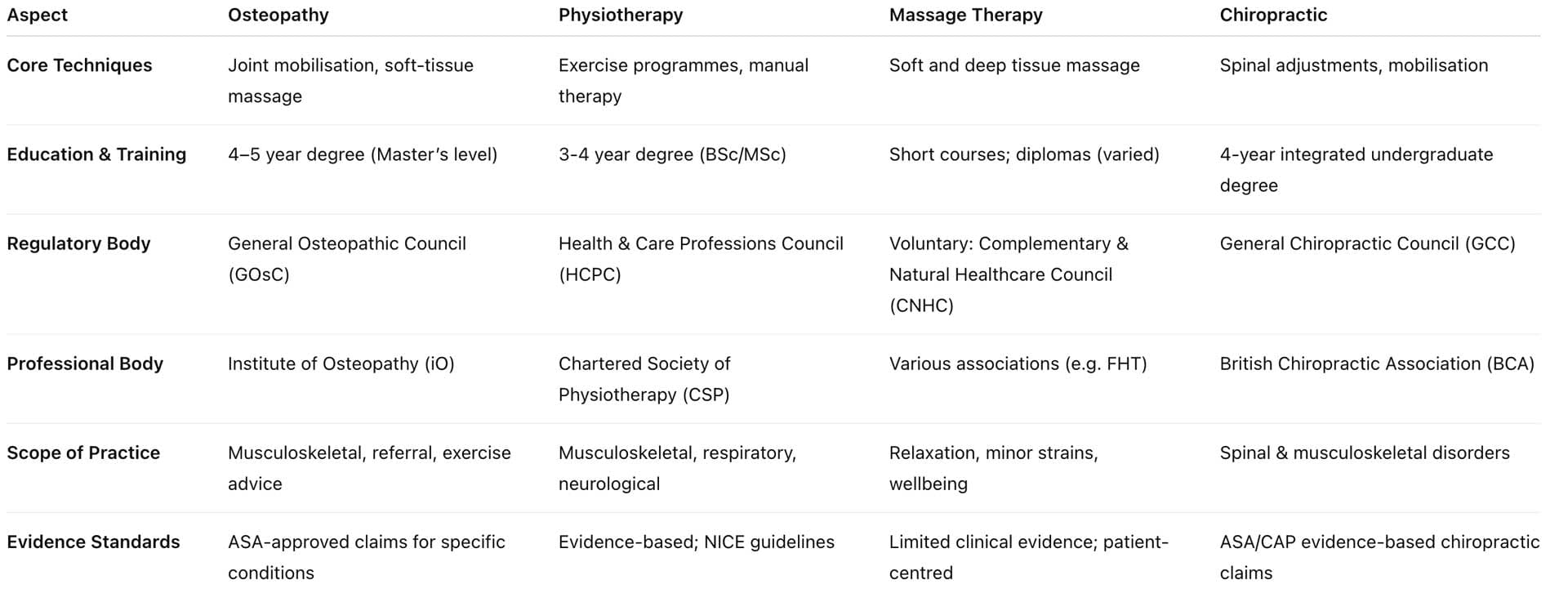

Osteopathy is one of several regulated routes to care for musculoskeletal pain. The right choice depends on your symptoms, your preferences and what is available to you. If you would like an osteopathic assessment, our team at Mappin House, 4 Winsley Street, London W1W 8HF, can explain what they find and whether you should see your GP first.
Book an appointment or see our fees.